Motorized Shades for High Windows in Two-Story Great Rooms
November 2, 2026
Why Motorized Shades for High Windows Make Sense
Two-story great rooms are built for light. The trouble starts around the second row of windows, the ones fifteen or twenty feet up that nobody can reach without a ladder. Those are the windows that let in the afternoon glare, and the ones that tend to stay uncovered for years because there's no good way to work them by hand.
That's the case for motorized shades for high windows. A shade you can't reach is a shade you won't use, and a shade that isn't used does nothing for heat, glare or privacy. Put a motor on it and the top row of glass behaves like any other window in the house.
We see a lot of these rooms. Accent Shutter & Shades has been fitting window treatments to Greater Houston homes for more than 35 years, and tall windows in wooded, two-story homes are a big part of that work.
Who Installs Motorized Shades in The Woodlands
Accent Shutter & Shades installs Hunter Douglas motorized shades, including PowerView Automation, in homes across The Woodlands, using its own installers rather than subcontractors. The company is an authorized Hunter Douglas dealer based on FM 2920 in Spring, next door to The Woodlands.
Homes there tend to have exactly the windows this post is about: big glass facing the trees, often stacked two stories high. If you're looking at motorized shades in The Woodlands, the decisions below are the ones worth settling before anything is ordered.
Our Hunter Douglas shades come in manual, battery and direct-wire versions, so the same shade style can be motorized in more than one way.
And because the company that measures your windows is the company that installs the shades, the job doesn't change hands halfway through. You can read what homeowners say about our installers in reviews from our customers.
Battery or Hardwired: The First Decision
Every motorized shade needs power, and there are two ways to get it there.
- Battery power. The battery sits behind or inside the shade, so nothing has to be wired into the wall. Hunter Douglas offers a rechargeable battery wand for PowerView shades and says a charge lasts up to a year, depending on how often the shade moves. Recharging a high shade means reaching it, so it's worth asking how the wand comes down or whether a spare can be swapped in.
- Hardwired (direct-wire) power. The shade runs on power brought to the window. No batteries to charge, ever, which is a real advantage on glass twenty feet up. The catch is that the wiring has to be there first, and that's work for an electrician, ideally while the walls are still open.
For an existing home with finished walls, battery power is usually the simpler route. For a new build or a big renovation, hardwiring the high windows is worth a serious look.
Which Shade Style Suits a Two-Story Room
Motorization doesn't limit the style much. The question is what the room needs from the top row of glass.
- Duette honeycomb shades add insulation at the window, which helps when tall glass faces the afternoon sun.
- Silhouette shades soften the light and filter glare and UV while still letting the room glow.
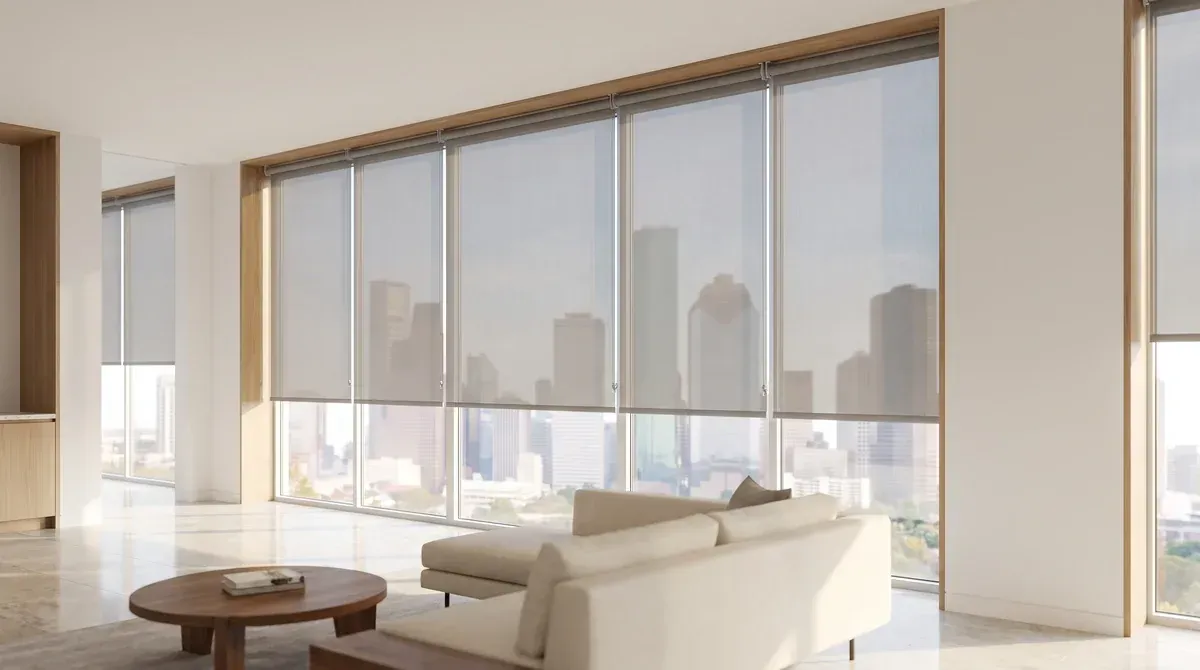
- Designer roller shades give the cleanest, simplest line on a wall of modern windows.
Matching matters more on a two-story wall than anywhere else in the house. The upper and lower rows sit in one view, so it usually makes sense to choose the same fabric and color for both (motorized up top, manual or motorized below).
App, Remote and Voice Control
PowerView shades can be run from the PowerView app on a phone, from a handheld remote, or by voice through Amazon Alexa, Google Assistant or Apple Home. Scenes group shades together, so one tap can drop every shade on the west wall at once.
Schedules are where the system earns its keep. PowerView can raise or lower shades at set times or tied to sunrise and sunset, so the high windows close before the late sun hits and open again in the morning without anyone touching a thing.
When to Plan the Wiring
Timing is the whole game with hardwired shades. If you're building or gutting a room, settle which windows get motorized before drywall goes up, so the electrician can run power to those openings while it's easy. Adding wire to a finished two-story wall later is possible, but it's a bigger and messier job. Mark the motorized windows on the plans, too, so the electrician and the trim carpenter both know where power and shade brackets will land.
For an existing home, battery power avoids that question entirely. Either way, the final measurements happen once the windows are in and the trim is on.
Common Questions About Motorized Shades
What happens to hardwired shades in a power outage?
They stop where they are until the power comes back. Battery shades keep working through an outage, which is one reason some homeowners put battery shades on the high windows even in a wired house.
Do PowerView shades need a hub?
Not always. A small, single-room setup can run from the app or the remote alone. The PowerView Gateway is what connects the shades to control from outside the house and to smart-home systems, so larger homes usually include one.
Are motorized shades loud?
They make a soft hum while they move. PowerView also has a quieter mode that runs shades at half speed, handy in a bedroom early in the morning, though it uses a little more battery.
How Accent Shutter & Shades Can Help
At Accent Shutter & Shades, we help homeowners choose the shade style, the power option and the controls for tall windows, then send our own installers to hang and set up the shades. To see how motorized shades would look on your high windows, schedule a free in-home consultation with Accent Shutter & Shades or call (281) 320-0009.